
Casino War Rules and Payouts NZ
November 5, 2026 · Oliver Bennett
Casino War Rules and Payouts NZ
Many players assume that table games requiring skill are the only way to engage with a casino floor meaningfully, yet purely luck-based options continue to draw steady crowds. The appeal often lies in absolute simplicity, where decisions are reduced to binary choices. When exploring options like a Spin Casino review, players frequently encounter straightforward card games that strip away memorized charts. This dynamic invites a closer look at mechanics that govern rapid rounds, fixed payouts, and the underlying mathematical realities of wagering without strategic depth. I have always found that simplicity in design can mask the underlying house edge, which is why keeping a close eye on your bankroll matters more here than ever.
The Core Setup and Dealing Mechanics
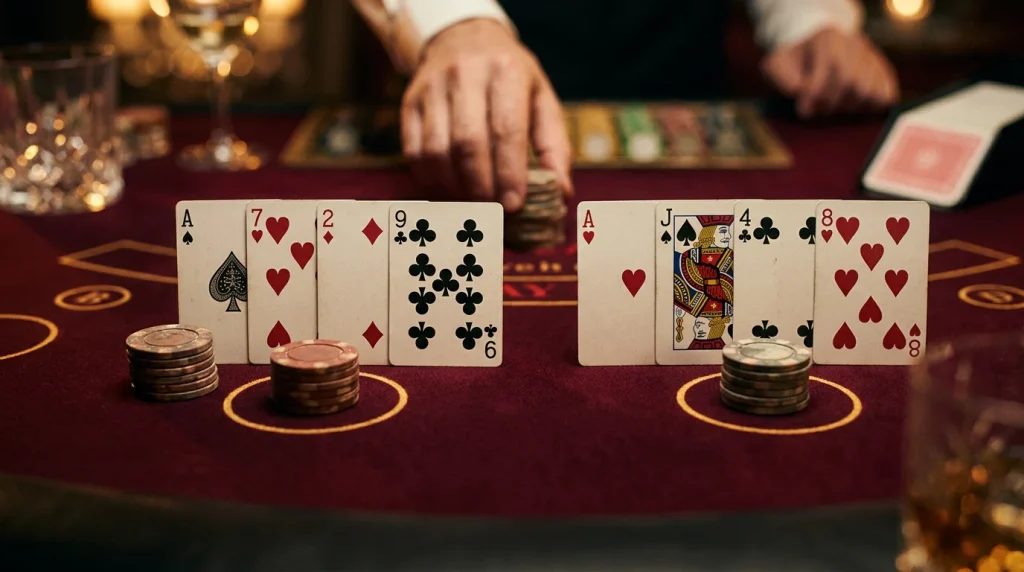
The foundational layout of the table mirrors a miniature baccarat or blackjack station, featuring marked betting circles and a dealer area. Standard decks, often numbering six or eight packed together, are shuffled continuously or placed in a shoe to maintain randomness. Unlike games where players hold complex hands, each participant receives just a single card face up, while the dealer takes one as well. This immediate confrontation removes drawn-out waiting periods, allowing dozens of hands to resolve within a single hour of play. Fast rounds mean money moves quickly, so setting a firm time limit before you start is just common sense.
Core Setup & Card Deal Layout
Interactive felt simulation: tap any table station to view its rule details.
How to Play Casino War Step by Step
Participating in a round begins long before any cards slide across the felt, requiring strict adherence to bankroll management principles. Players place a primary wager in the designated main box before the dealer signals the close of betting. Once cards are exposed, the higher rank wins outright, with standard card hierarchy applying from two up to the ace. If values match, a tie occurs, triggering the critical fork in the road where participants must choose between surrendering half their stake or doubling down to fight. For a broader perspective on table game dynamics, readers can examine a Spin Casino review to see how digital platforms handle similar rapid-fire mechanics. Never chase losses when a tie goes against you; accept the variance as part of the cost of play.
Round Decision Ladder
Step through each stage from the primary bet to the tie resolution.
—
—
Understanding the Tie Wager and Side Bets
Beyond the primary game, optional wagers add volatility for those willing to risk additional funds on exact outcomes. The tie bet predicts that both player and dealer will draw matching ranks, typically offering a payout of ten to one. While this looks appealing on paper, the house edge on side wagers is notoriously steep compared to the main game. Responsible participants generally treat these optional fields with caution, recognizing that chasing high multipliers frequently accelerates bankroll depletion. Setting strict limits before sitting down ensures that side bets remain a minor diversion rather than a financial hazard. If you feel tempted to load up on side bets, it might be a good time to step back and use a deposit limit tool.
Evaluating Casino War Strategy Realities
A common misconception is that tactical decisions can alter the long-term mathematical disadvantage inherent in the system. When a tie arises, mathematically sound advice suggests going to war rather than surrendering, because surrendering guarantees a fifty percent loss of the original bet. However, going to war requires matching the initial stake, meaning total exposure doubles on a single hand. No betting system can overcome the inherent house edge, which stems from the dealer winning ties if no war is declared. Recognizing these boundaries helps maintain a sober mindset, keeping entertainment separate from financial expectations. I always remind people that no strategy turns a negative expectation game into a winning one.
Table of Game Metrics and House Edges
| Item | Number | Comment |
|---|---|---|
| Standard Decks | 6 | Common shoe size used in physical and digital tables. |
| Main House Edge | 2 | Approximate percentage favoring the casino on main bets. |
| Tie Bet Payout | 10 | Standard multiplier awarded when both cards match. |
| Tie Bet Edge | 18 | Significantly higher house advantage on the side wager. |
| Surrender Cost | 50 | Percentage of the initial stake lost on surrender. |
- Standard Decks6
- Main House Edge2
- Tie Bet Payout10
- Tie Bet Edge18
- Surrender Cost50
Game Metrics & House Edge Disadvantage
Compare the mathematical boundaries and costs of each table wager.
—
Common Mistakes to Avoid at the Table
- Failing to establish a firm session budget before placing the first wager.
- Relying heavily on tie side bets while ignoring the main game math.
- Doubling up during a war phase without accounting for total risk exposure.
Legal Framework and Regulation in New Zealand
Engagement with digital platforms or physical venues in New Zealand operates under the oversight of the Department of Internal Affairs in accordance with local legislation. While domestic online operations face strict licensing limits, adults frequently access international sites that feature table games like the ones discussed here. Understanding local legislative boundaries ensures participants remain informed about consumer protections and safe access protocols. Self-exclusion tools and deposit limits remain essential safeguards, reinforcing the principle that gambling should function strictly as a controlled form of leisure. Should gambling ever stop being fun, remember that self-exclusion tools are readily available to help you take a necessary break without any shame or fuss.
Frequently asked questions
What happens if the player and dealer tie?
A tie forces a choice between surrendering half the initial wager or going to war by doubling the stake.
Is there a reliable strategy to win consistently?
No strategy overcomes the house edge; going to war is mathematically superior to surrendering, but the casino retains an advantage.
What is the payout for a standard win?
Winning a normal hand without a tie pays even money, returning an amount equal to the original wager.
Are side bets worth playing?
Side bets offer higher payouts like ten to one, but they carry a much larger house edge and deplete funds faster.
Can I practice this game for free?
Many digital platforms offer demo modes that allow players to test mechanics without risking real money.
What this means in practice
Casino War offers an exceptionally direct format for individuals who prefer fast rounds and simple card comparisons over intricate tactical rules. This style suits players seeking light entertainment with clear outcomes and minimal learning curves. Conversely, it does not suit those who enjoy deep strategic planning or players looking for low house edges, as the mathematical disadvantage is relatively fixed. Maintaining firm personal limits and viewing every session as a paid form of entertainment remains essential for balanced participation. Keep your stakes modest, know when to walk away, and treat the house edge simply as the price of admission. The constant risk of losing your entire bankroll on a bad run of ties remains a harsh reality that tests even the most disciplined player.